Recent advancements in seismic data analysis have improved our understanding of the complex structures deep within the Earth, particularly near the boundary between the Earth’s core and mantle, known as the core–mantle boundary (CMB). Using a technique called seismic tomography—which creates images of the Earth’s interior by analyzing seismic waves—scientists have identified large regions in the lower mantle where seismic waves travel unusually slowly. These regions are called large low shear velocity provinces (LLSVPs) and are located beneath the Pacific Ocean and South Africa.
Despite this progress, different models have shown variations in the smaller details of these regions, leading to questions about their exact nature and how they formed. To address this, Kai-Jie Hu, a former M.S. student of IOINTU, and his advisor, Prof. J. Y.-T. Ko used data from the USArray, a network of seismic stations that operated across the United States from 2007 to 2014. They measured the differences in arrival times of seismic waves, specifically P-waves (primary waves that are the fastest type of seismic waves), as they traveled through the Earth. By averaging these P-wave travel times and calibrating them with diffracted P-waves (waves that bend around structures), They were able to minimize the distortions caused by variations in the Earth’s upper layers. This allowed them to focus more accurately on the deeper structures near the CMB.
Their findings confirm that this method effectively maps seismic anomalies—areas where seismic waves speed up or slow down—beneath the USArray network, matching results from other studies in North America. After the corrections, they discovered sharp changes in seismic wave travel times over relatively short distances, such as those across the northern boundary of the mid-Pacific anomaly. This suggests that the Pacific LLSVP is chemically diverse, meaning it has variations in its composition. These findings enhance our understanding of the Earth’s deep interior and provide insights into the dynamic processes occurring near the core–mantle boundary.
Ko, J. Y.-T.*, and K.-J Hu (2024), Refining Heterogeneities Near the Core-Mantle Boundary Beneath East Pacific Regions: Enhanced Differential Travel Time Analysis Using USArray, Geosciences, 14, 309. https://doi.org/10.3390/geosciences14110309.
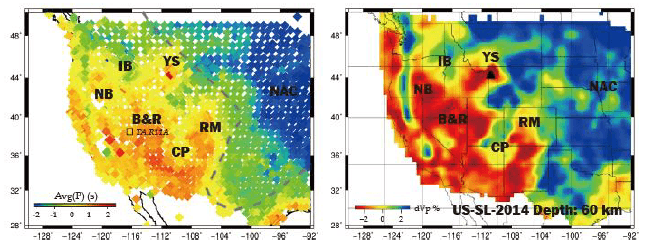
Fig. 1 Comparison of averaged P wave travel-time anomalies with the US SL 2014 tomographic model at 60 km depth. Travel time measurements were initially referenced to station TA.R11A, denoted by a black-framed square, prior to averaging. Notable geological features are labeled NB Newberry Caldera; IB Idaho Batholith; SRP Snake River Plain; YS Yellowstone Caldera; B&R Basin and Range; RM Rocky Mountains; CP Colorado Plateau.