Research led by master’s student Yi-Hsuan Lo and Prof. Chih-hao Hsieh at the Institute of Oceanography, National Taiwan University, together with Dr. Wan-Hsuan Cheng at the Institute of Fisheries Science, NTU, revealed how Typhoon Maria rapidly altered the structure and functions of bacterioplankton communities across multiple depths in the southern East China Sea. By conducting in situ sampling within one week before and after the typhoon, the team captured, for the first time, the immediate response of open-ocean bacterial communities to typhoon disturbance. The findings were published in the Journal of Geophysical Research: Oceans on May 24, 2026.
Amid global climate change, the frequency and intensity of typhoons are expected to rise, highlighting the need to understand their effects on marine biogeochemical cycles. Understanding the responses of bacterioplankton is particularly important, as these microorganisms regulate organic matter decomposition, drive nutrient regeneration, and facilitate energy transfer to higher trophic levels. Although previous research has explored how typhoons affect bacterioplankton in coastal areas, the responses of open-ocean bacterioplankton communities remain poorly understood. This gap is particularly significant because the physical impacts of typhoons can differ greatly with depth in the open ocean, potentially causing layered responses in microbial communities throughout the water column. However, such vertical dynamics in open-ocean bacterioplankton have remained largely unexplored, primarily due to the logistical difficulty of conducting timely in situ sampling during storm events.
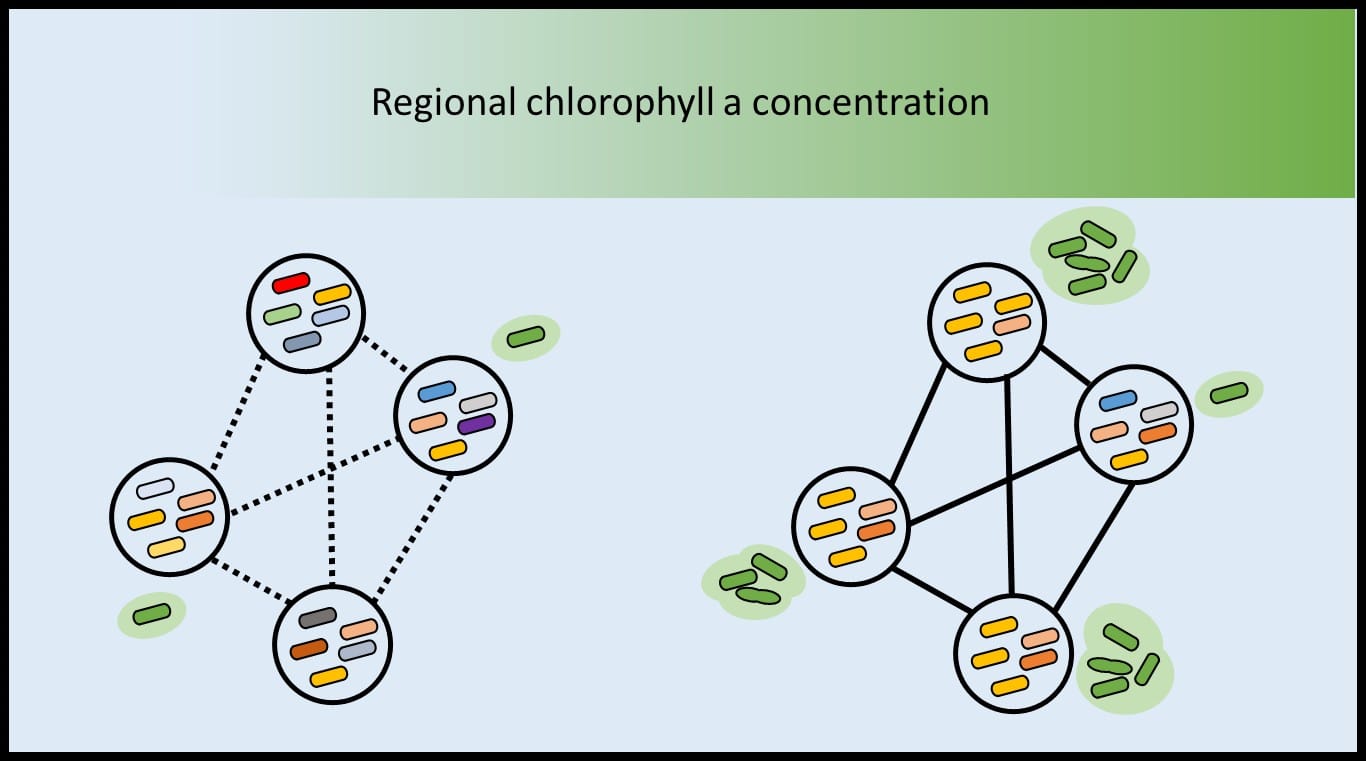
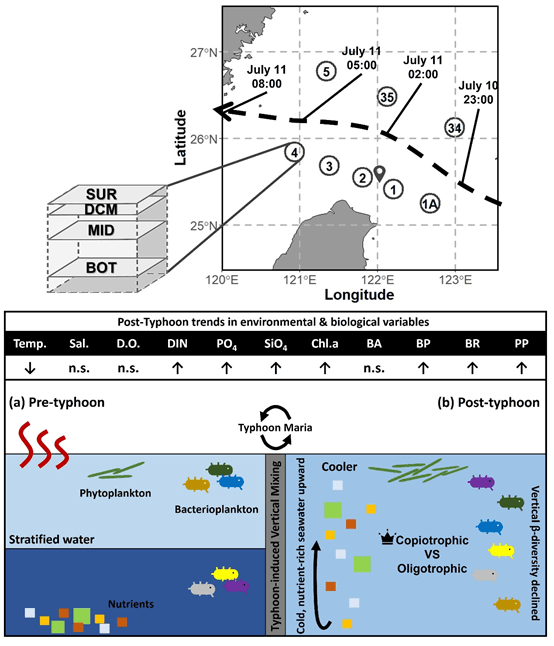
To address this limitation, the research team leveraged a rare opportunity in July 2018 when Category 5 Typhoon Maria crossed the southern East China Sea (July 10–11), intercepting a scheduled oceanographic cruise. The team conducted high-resolution, in situ sampling at eight stations and four distinct depth layers within a strict one-week window immediately before (July 6–8) and after (July 13–16) the storm’s passage. Physicochemical analyses revealed that intense, typhoon-induced vertical mixing profoundly altered the water column’s structure, causing a distinct drop in sea surface temperature alongside significant enrichments in nutrient concentrations and chlorophyll-a. Elevated nutrient availability further stimulated microbial metabolism, as reflected by increased bacterial production and respiration rates. This metabolic surge coincided with the enrichment of copiotrophic taxa, including members of Alteromonadaceae and Rhodobacteraceae, and a concurrent decline in oligotrophic lineages such as SAR11.
Importantly, these microbial responses exhibited strong depth dependence. Nutrient enrichment was more pronounced in the upper water column, the dominant responding taxa varied among depth layers, and the environmental factors driving community restructuring differed vertically. In addition, the typhoon reduced vertical β-diversity across the water column, indicating that microbial communities at different depths became more similar after the event. This homogenizing effect was strongest between more distant depth strata, suggesting that typhoon-driven vertical mixing weakened stratification-defined niche boundaries and promoted taxonomic exchange across depths, ultimately increasing community homogeneity over broader vertical scales.
Collectively, these findings provide rare and valuable in situ evidence demonstrating that typhoons can rapidly restructure open-ocean microbial ecosystems within a very short time frame. The study highlights the complex and multifaceted ways in which extreme weather events reshape microbial community structure and ecological functioning, offering new insights into how climate-driven increases in typhoon activity may influence marine microbes and ocean biogeochemical cycles.
Reference: Lo, Y.-H., Lai, C.-C., Chen, T.-Y., Yeh, Y.-C., Shiah, F.-K., Cheng, W.-H., & Hsieh, C.-h. (2026). Typhoon-induced vertical mixing rapidly reshapes bacterioplankton communities across ocean depths. Journal of Geophysical Research: Oceans, 131, e2025JC023738. https://doi.org/10.1029/2025JC023738