Some microorganisms living on the seafloor consume methane leaking up from beneath the sediment. A new study from the Institute of Oceanography, National Taiwan University, led by postdoctoral researcher Dr. Pierrick Fenies and Associate Professor Dr. Sze Ling Ho, shows that these microbes may be corrupting the chemical signals scientists use to reconstruct past ocean temperatures, by up to nearly 10°C.
To understand past climates, researchers rely on chemical compounds preserved in seafloor sediments. Among these, a group of molecules called OH-isoGDGTs acts as a natural thermometer: they are produced by microorganisms living near the ocean surface, and their chemical structure changes with water temperature. By analysing these molecules in ancient sediments, scientists can estimate what sea surface temperatures looked like thousands to millions of years ago.
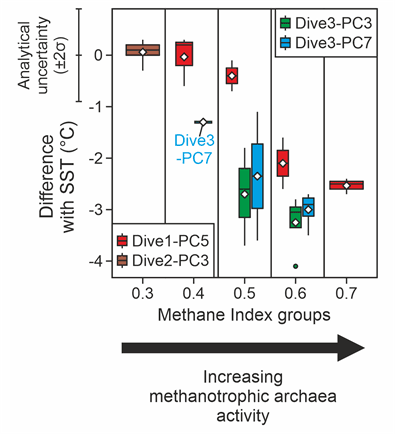
The problem uncovered in this study is that a group of methane-eating archaea found in cold seeps, areas where methane gas seeps up through the seafloor, also produces OH-isoGDGTs. Their version of these molecules, however, does not reflect sea surface temperature. Instead, it reflects their own metabolism. When enough of these molecules accumulate in the sediment, they can distort the temperature signal, leading to reconstructed temperatures that are off by up to 9.7°C: a massive error, given that the entire temperature difference between the Last Glacial Maximum and the Holocene is only about 3°C in this region.
The good news is that the researchers find the existing screening tool, the Methane Index, to reliably identify contaminated samples and flag them for exclusion, meaning the climate record can still be trusted, as long as this quality check is applied.
Cold seeps occur along continental margins worldwide, and OH-isoGDGT-based temperature reconstructions are increasingly used in palaeoceanography. These findings provide a practical framework for ensuring the reliability of this tool beyond the open ocean.
This study was published in the official journal of the European Association of Organic Geochemists Organic Geochemistry.
Further reading:
Fenies, P., Ho, S.L., Hefter, J., Lee, P.-T., 2026. Impact of anaerobic methanotrophic archaeal input on hydroxylated isoprenoid GDGT-derived temperatures. Organic Geochemistry 218, 105213. https://doi.org/10.1016/j.orggeochem.2026.105213