本研究由臺灣大學海洋研究所碩士生陳品嶧與謝志豪教授、葉怡君教授共同領導,揭示了海洋異營細菌群聚組成過程 (assembly processes) 如何隨著葉綠素 a 濃度梯度而改變。研究發現,隨著葉綠素 a 濃度升高,群聚組成由隨機性 (stochastic) 為主導的過程,逐漸轉變為決定性 (deterministic) 為主導的過程。研究成果已於 2026 年 7 月 28 日發表於微生物生態學期刊 《ISME Communications》。
了解微生物群聚如何組成,是解析海洋微生物地理分布及預測海洋生物地球化學循環的重要基礎。然而,在受海流與營養鹽供應共同影響的陸棚海域,環境梯度如何影響微生物群聚組成過程,至今仍缺乏完整的了解。本研究以區域葉綠素 a 梯度作為環境指標。過去研究指出,葉綠素 a 濃度較高的海域通常具有較高的浮游植物生產力,並可提供更多浮游植物來源的有機物,進而選擇性地促進特定異營細菌的生長。因此,研究團隊推測,在高葉綠素 a 環境下,決定性組成過程將扮演較重要的角色;相對地,在低葉綠素 a 環境下,隨機性組成過程則較為重要。
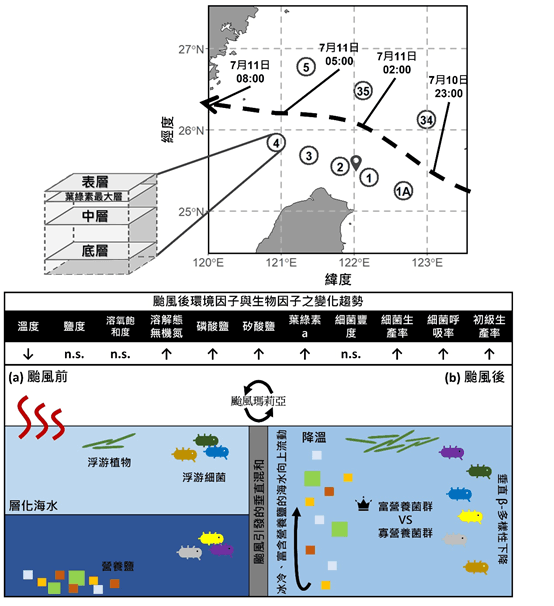
為探討葉綠素 a 梯度下的微生物群聚組成過程,研究團隊整合 2014 至 2018 年共 13 個海洋航次的調查資料,分析南東海一條長達 280 公里的跨陸棚測線,涵蓋由近岸至外海的八個測站。研究結果顯示,各航次間具有明顯的區域葉綠素 a 梯度,其中較高的葉綠素 a 濃度與垂直混合及營養鹽輸入密切相關。此外,在高葉綠素 a 濃度條件下,與浮游植物相關的細菌類群,如 Flavobacteriales 與 Rhodobacterales,以及超微浮游植物 (picophytoplankton) 中的 Synechococcales,其相對豐度皆隨葉綠素 a 濃度增加而提高,顯示微生物群聚逐漸朝向與高初級生產力相關的組成轉變。
研究團隊進一步採用方差分解分析 (Variation Partitioning Analysis, VPA) 架構,區分不同的異營性細菌群聚組成過程。結果發現,隨著區域葉綠素 a 濃度增加,超微浮游植物的生物篩選作用逐漸增強,顯示超微浮游植物與異營性細菌之間可能存在重要的生態交互作用。 另一方面,葉綠素 a 濃度與播遷限制 (dispersal limitation) 呈負向關係,可能反映高生產力海域具有較強的水團交換作用。整體而言,決定性組成過程的重要性也隨葉綠素 a 濃度增加而提升,而隨機性組成過程的重要性則相對降低。在各種決定性組成過程中,生物篩選對群聚組成的解釋能力高於環境篩選 (environmental filtering),可能反映生態緩衝效應 (ecological buffering),即生物間交互作用增強後,降低群聚對環境變動的敏感性。
本研究揭示了海洋異營細菌群聚的組成過程如何隨區域葉綠素 a 濃度梯度發生轉變,並突顯了生物間交互作用在細菌群聚中的重要性。研究成果有助於對海洋微生物生態與生物地球化學循環有更深的理解,並為未來預測海洋微生物生態系對環境變化的反應提供新的科學基礎。
Reference: Chen, P. Y., Shiah, F. K., Gong, G. C., Hsieh, C. H., & Yeh, Y. C. (2026). Chlorophyll a gradients shift heterotrophic bacterial assembly from dispersal limitation to biotic filtering of picophytoplankton. ISME Communications, ycag215. https://doi.org/10.1093/ismeco/ycag215

Schematic of heterotrophic bacterial community assembly along a regional chlorophyll a gradient. Networks represent metacommunities composed of local community patches (circles) linked by dispersal paths (lines). At low chlorophyll a concentrations (left), assembly is dominated by stochastic processes characterized by high dispersal limitation and weak biotic filtering of picophytoplankton. Conversely, at high chlorophyll a concentrations (right), assembly shifts toward deterministic processes driven by lower dispersal limitation and strong biotic filtering of picophytoplankton.
.
A study led by master’s student Pin-Yi Chen, Prof. Chih-hao Hsieh and Prof. Yi-Chun Yeh at the Institute of Oceanography, National Taiwan University, has uncovered how the assembly processes of marine heterotrophic bacterial communities change across a chlorophyll a gradient. The study found that as the regional chlorophyll a concentration increased, the relative importance of community assembly transitioned from stochastic to deterministic processes. The findings were published in ISME Communications on July 28, 2026.
Understanding how microbial communities assemble (i.e., changes in species composition across sites) is essential for explaining the biogeographic distribution of marine microorganisms and predicting biogeochemical cycling in the ocean. Nevertheless, the assembly processes along environmental gradients have remained elusive, especially in continental shelf regions shaped by dynamic ocean currents and nutrient supply. In this study, the regional chlorophyll a gradient was used as an environmental proxy. Previous studies have shown that environments with higher chlorophyll a generally support greater phytoplankton productivity and provide larger amounts of phytoplankton-derived organic matter, which can selectively promote the growth of specific heterotrophic bacteria. Consequently, deterministic assembly processes were expected to become more important with increasing chlorophyll a concentrations, whereas stochastic processes were expected to dominate under lower chlorophyll a concentrations.
To investigate microbial assembly across a chlorophyll a gradient, the research team synthesized observational data from 13 cruises conducted between 2014 and 2018. The study covered a 280-km cross-shelf transect in the southern East China Sea, including eight stations spanning nearshore to offshore waters. The results revealed a distinct regional chlorophyll a gradient across the cruises, with higher chlorophyll a concentrations closely associated with vertical mixing and nutrient inputs. Under high chlorophyll a conditions, the relative abundances of phytoplankton-associated bacterial groups, including Flavobacteriales and Rhodobacterales, together with the picophytoplankton order Synechococcales, became increasingly dominant, indicating a shift toward communities associated with higher primary productivity.
The research team further applied a Variation Partitioning Analysis (VPA) framework to quantify assembly processes shaping heterotrophic bacterial communities. The results showed that as regional chlorophyll a concentrations increased, biotic filtering of picophytoplankton became stronger, suggesting potentially important ecological interactions between picophytoplankton and heterotrophic bacteria. In contrast, dispersal limitation decreased with increasing chlorophyll a, consistent with greater water-mass exchange under high-productivity conditions. Consequently, the relative importance of deterministic processes compared to stochastic processes increased with the regional chlorophyll a concentration. Among the deterministic processes, biotic filtering explained more variation than environmental filtering, suggesting an ecological buffering effect in which stronger biotic interactions reduce the influence of environmental variability on bacterial community assembly.
This study reveals how heterotrophic bacterial community assembly shifts across a regional chlorophyll a gradient and highlights the importance of biotic interactions in bacterial communities. The findings contribute to a deeper understanding of marine microbial ecology and biogeochemical cycling and provide a new scientific basis for predicting how marine microbial ecosystems may respond to environmental change.